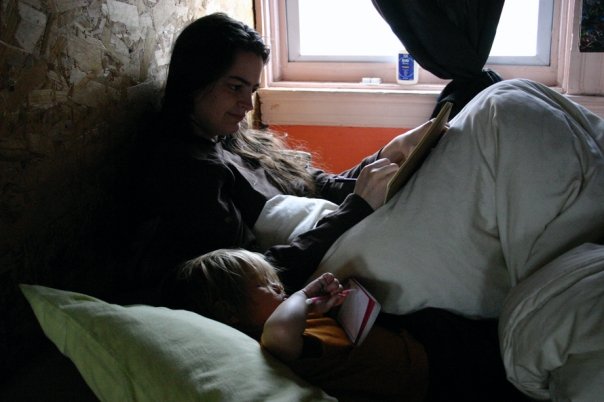
So, we've been playing a lot of Minecraft around here. By we I mostly mean River, but it does rub off on everyone. Violet really likes to sing the song TNT, for example. There is a fair amount of staring at the computer, but it's not just staring at the computer (it pretty much never is). We get huge murals of the Minecraft creatures on a near-daily basis, for one thing. We've also delved into Minecraft papercraft, and James even helped River make a couple of creatures from wood.
Since everything in Minecraft is made of blocks, lego is another very compatible medium. There is an official lego Minecraft set, but because the price went up so quickly, we've decided to stick with simpler lego tutorials for now. River even made a video of his own to show his creations! (We've discovered that you can buy legos by the piece if there are particular blocks you're missing.) River also likes to create things in the game itself. He's used tutorials like this one to teach himself to build epic sculptures of mobs like the skeleton, which involve a lot of memorization, digital navigation and general spatial skills.
Since the blocks in Minecraft are perfectly regular it's pretty hard to avoid the math implications, beginning with measuring length, width and height in block units. River often comes up with multiplication questions based on problems like "how many blocks do you need to make four legs that are three units tall?" As my mom pointed out, they are a lot like the cubes often used as manipulatives in math classes. I wanted to link to some Minecraft math demonstrations, but there are so many that it's hard to choose. Here's a search for "Minecraft math" with some interesting links, but the best bet would probably be to search for a topic of particular interest like addition - for example, this addition gate combines Minecraft, math, and basic programming concepts.
There is actually a lot of computer and tech stuff in Minecraft play. River has built some pretty impressive double-switched gates and similar machines, which I don't even completely understand. James likes to point out that he (River) has learned most of what he knows about Minecraft from other kids, both in person and on Youtube videos. Just last week we logged on to a server with other local homeschoolers, who were able to help us figure out the rules of the social game, while River was thrilled to get a chance to share some of his technical knowledge. We're thinking of checking out the Snap Circuits Jr. kit to see if he has any interest in exploring similar concepts in three-dimensions.
In the meantime, there's a whole world to explore, full of different biomes, cities, people and materials. A world which is, apparently, larger than the whole earth. No wonder it's taking a while.
(post image from the Paradise World blog)
Showing posts with label unschooling. Show all posts
Sunday, July 29, 2012
Tuesday, July 24, 2012
NOCTURNAL (LEARN NOTHING DAY)
Meanwhile, River was teaching himself things about how to build better lego monsters. Seriously, they were much more realistic than the last ones I saw. Is that technically learning? I'm not sure. It was a demonstration of knowledge acquisition, but it's hard to say exactly when that learning took place.
That is kind of like one of the biggest things I'm learning right now, too, which is that we need to be more flexible about sleep around here. It has been sneaking up on us for a while. Really, we are all sort of nocturnal. Before kids and regular employment, James and I used to go to bed around 4:00 AM. When we had little babies they adjusted to our schedule pretty easily, though it was somewhat earlier than it used to be.
They're not little babies any more, though, especially River, who has aometimes been wanting to stay up later than we do for about the past year. It's been a gradual thing. at first the rest of us would lie down and watch a movie and he would stay up to watch a video or two of his own before joining us around when we went to sleep. Eventually we noticed that it was getting more extreme, though. Sometimes he seemed full of energy at night, while at other times he just seemed determined to stay awake in the face of exhaustion. Since early spring, he has often been staying up most of the night.
Some part of me would like to say that we supported this right away, but we didn't. Instead, we tried pretty much everything we could think of, from a structured night-time routine to installing a program that cuts out melatonin-reducing blue light from River's computer. On the few nights we did get him in bed early, he still lay awake tossing and turning, sometimes for over an hour. Mostly we tried waking him up in the morning (with his consent) for the many day-time activities he enjoys. This went on for a surprisingly long time (weeks?) without any noticeable night-time effect. What we did notice was that he got more and more exhausted - droopy, grumpy, and eventually nearly impossible to wake up.
And so, after many conversations and consultations, we've decided to let him sleep. Today was a pretty average day, and he got up around three. most nights now James and I trade off staying up with him for at least a couple of hours after our usual night-time routine. It's certainly not an ideal schedule for us, but it may be the best compromise at the moment - and there are benefits for all of us. When River is well rested, he is much more cooperative, engaged and affectionate. When I stay up with him, if I'm not too tired, we have fun drawing, building with legos, and talking about all kinds of crazy stuff. In the mornings I get some alone time with Violet, too, when we can have a leisurely breakfast, play toddler games, and get some housework done. It is a big adjustment, though.
There are plenty of unschooling truisms like "you can have structure without having rules" which, while technically accurate, leave out the dirty semi-secret that this structure often has a way of occurring in the wee hours of the morning, and we've struggled more with this than with any other unschooling issue so far. Wouldn't it be better to just put River to bed over his objections, for his own good? The thing is, he seems to be doing just fine as long as we let him sleep enough, even if it is usually during the day. And although it's not what we might have chosen, the rest of us can be too, especially if we concentrate on meeting our own needs (for down time, getting out of the house, and so on).
I guess it comes down to the fact that we believe in unschooling not just politically (it's rarely right to force another person to do anything against their will), but also pedagogically - much like you just can't force someone sleep if they're not tired, you also can't force someone learn something when they're not open to it. On the other hand, even on learn-nothing day, there doesn't seem to be any way in the world to stop anyone from learning.
Saturday, April 21, 2012
ANGRY BIRDS, LAZY DAYS
I haven't posted about my awesome kids recently, have I?
River has spent most of the past year immersed in the world of construction, but apparently construction is now over. The theme for this spring has been video games.
Angry Birds, Mario, Minecraft, and more Angry Birds, mostly. The thing that intrigues me most about this is that while he does spend a lot of time playing games (and watching game videos), he spends even more time recreating the video worlds in various forms: role playing, play-doh, cut cardboard, real slingshots, bath toys, and stuffed birds with blocks come to mind. Angry Birds Space had us pulling out a solar system book last week, ending a significant reading drought. Lego is perfect for Minecraft, of course, although we've also seen our fair share of stone axes and other real-world tools. And then there are the drawings, which, while they've never been River's primary focus, tend to happen on a large scale, usually several times a day. The longest and most recognizable phrase he has written so far is on a recent drawing: Angry Birds Underwater.
We've had some really amazing conversations, recently, too. One of his favorite subjects to explore is how people came to exist, and then how they learned to build houses. He's asked to play letter and number games, recently, too, and I'm learning to be amazed at how much he picks up when he's not actively working on things. Why can he do more equations than he could last time we talked about subtraction? I don't know, but he can.
And Violet... I feel like maybe I don't write much about what Violet does. At her age, I'm sure I had lots of theories about what River was into, but so far Violet has been very easygoing and mostly just into whatever is going on. She does like a lot of the things that River likes, but some more than others. Recently she's also been enjoying Angry Birds, especially the part about building towers and knocking them over. She's also been fascinated with letters. She plays quite a bit of Starfall, loves to be read to, and I wouldn't be entirely surprised if she ends up reading before River does. She's also been enjoying dolls, stuffed animals, and of course, horrifying daredevil stunts. We're going to try to get to a sample gymnastics class soon and see if River can tolerate it, because I'm pretty sure Violet will love it.
River has spent most of the past year immersed in the world of construction, but apparently construction is now over. The theme for this spring has been video games.
Angry Birds, Mario, Minecraft, and more Angry Birds, mostly. The thing that intrigues me most about this is that while he does spend a lot of time playing games (and watching game videos), he spends even more time recreating the video worlds in various forms: role playing, play-doh, cut cardboard, real slingshots, bath toys, and stuffed birds with blocks come to mind. Angry Birds Space had us pulling out a solar system book last week, ending a significant reading drought. Lego is perfect for Minecraft, of course, although we've also seen our fair share of stone axes and other real-world tools. And then there are the drawings, which, while they've never been River's primary focus, tend to happen on a large scale, usually several times a day. The longest and most recognizable phrase he has written so far is on a recent drawing: Angry Birds Underwater.
We've had some really amazing conversations, recently, too. One of his favorite subjects to explore is how people came to exist, and then how they learned to build houses. He's asked to play letter and number games, recently, too, and I'm learning to be amazed at how much he picks up when he's not actively working on things. Why can he do more equations than he could last time we talked about subtraction? I don't know, but he can.
And Violet... I feel like maybe I don't write much about what Violet does. At her age, I'm sure I had lots of theories about what River was into, but so far Violet has been very easygoing and mostly just into whatever is going on. She does like a lot of the things that River likes, but some more than others. Recently she's also been enjoying Angry Birds, especially the part about building towers and knocking them over. She's also been fascinated with letters. She plays quite a bit of Starfall, loves to be read to, and I wouldn't be entirely surprised if she ends up reading before River does. She's also been enjoying dolls, stuffed animals, and of course, horrifying daredevil stunts. We're going to try to get to a sample gymnastics class soon and see if River can tolerate it, because I'm pretty sure Violet will love it.
Sunday, April 15, 2012
DRAWING LAB #4: ZOOPHILIA
This week (ok, let's be honest, last week) my drawing exercise was to sketch at the zoo. I wasn't that excited about going by myself, so I asked River if he wanted to draw at the zoo with me. He was pretty excited about it until he realized I meant draw animals. His favorite thing to draw right now is Minecraft stuff, i.e. anything made out of squares.

While I was drawing, I was thinking about what makes a simple drawing successful. The bulky shapes (like you get from a gesture drawing) are important, but so are certain details. For example, look at this thing on the left. It's probably a gorilla. But the one on the right is definitely a gorilla. This bear was my favorite real sketch from the trip (the gorillas are fake, sorry) and a little of the same thing happened naturally, since the claws on that paw just happened to be showing.
I did have to be pretty quick with most of the animals. This is the only one that I actually got to spend a long time on, since he was distracted by the slides for quite a while and didn't even see me drawing. (And thanks for that idea, Steph.)
I asked River if he wanted to draw any animals and at first he insisted that he didn't know how, but then he decided to try some "minecraft" versions: elephant and flamingo. It's a good technique, I think. He got all the major parts blocked in. And yes, that is TNT in the corner.
I was left with one burning question after our zoo trip, which is why would a fish have nostrils? River says, "umm, water nostrils." Of course.

While I was drawing, I was thinking about what makes a simple drawing successful. The bulky shapes (like you get from a gesture drawing) are important, but so are certain details. For example, look at this thing on the left. It's probably a gorilla. But the one on the right is definitely a gorilla. This bear was my favorite real sketch from the trip (the gorillas are fake, sorry) and a little of the same thing happened naturally, since the claws on that paw just happened to be showing.
I did have to be pretty quick with most of the animals. This is the only one that I actually got to spend a long time on, since he was distracted by the slides for quite a while and didn't even see me drawing. (And thanks for that idea, Steph.)
I asked River if he wanted to draw any animals and at first he insisted that he didn't know how, but then he decided to try some "minecraft" versions: elephant and flamingo. It's a good technique, I think. He got all the major parts blocked in. And yes, that is TNT in the corner.
I was left with one burning question after our zoo trip, which is why would a fish have nostrils? River says, "umm, water nostrils." Of course.
Monday, February 27, 2012
Strewing: River's Bucket List (Part 2)
I'm not sure if it's an unschooling thing or just a mom thing, but I tend to keep a mental list of things River has mentioned that he would like to do some day. Here's a recent one, with notes:
build a treehouse - ours won't be this ambitious, but the playground built by children is an inspiration.
make a birdfeeder/watch birds - the pine cone is classic, and kid-friendly
go to the woods
go to the playground
go to the unschoolers waterpark gathering again (don't forget toy bag this time)
make a train shaped lunchbox - this is a craft in a book, which unfortunately is not online. maybe I'll post pictures if it happens, 'cause it is pretty crazy.
go to a drive-in movie - maybe this one? looks like The Lorax is playing right now.
go through a car wash - I bet he would also like this kids' version
go back to the beach (bring toy trucks)
learn to read - we've seen a lot of Starfall recently
build and drive a race car - naturally this made me think of soap box derby. apparently it's still a thing, although I don't see a lot of soap boxes
go to outer space - this has been on the list a long time, and it's not getting checked off any time soon. but you never know...
build a treehouse - ours won't be this ambitious, but the playground built by children is an inspiration.
make a birdfeeder/watch birds - the pine cone is classic, and kid-friendly
go to the woods
go to the playground
go to the unschoolers waterpark gathering again (don't forget toy bag this time)
make a train shaped lunchbox - this is a craft in a book, which unfortunately is not online. maybe I'll post pictures if it happens, 'cause it is pretty crazy.
go to a drive-in movie - maybe this one? looks like The Lorax is playing right now.
go through a car wash - I bet he would also like this kids' version
go back to the beach (bring toy trucks)
learn to read - we've seen a lot of Starfall recently
build and drive a race car - naturally this made me think of soap box derby. apparently it's still a thing, although I don't see a lot of soap boxes
go to outer space - this has been on the list a long time, and it's not getting checked off any time soon. but you never know...
Thursday, August 18, 2011
Strewing: Anatomy
This paper plate skeleton is goofy, but could be fun to construct and hang.
These skeleton cookies are adorable, though. Looks like the original post is gone now, but you get the idea.
Someone recommended the Melissa and Doug anatomy floor puzzle. It has bones on one side, organs on the other. It's a little advanced for River, but he was excited to have us help him put it together a few times.
We haven't explored it much yet, but the Google body browser looks really interesting and definitely more in-depth than these other ideas.
One that River came up with himself was to take his clothes off and ask me to draw bones on him with washable marker. That was fun. We also draw bones and blood people on paper pretty regularly.
For Pittsburghers, the Carnegie Science Center has some really good anatomy and medical technology stuff for all ages in the changing exhibits.
Looking for an image for this post, it occurred to me to show him the Alex Grey books...plenty of anatomy in those paintings (like the image above).
Tuesday, June 15, 2010
Loving Books, Loving Kids
I come from a book loving family. My mom is a librarian, my sister works in publishing, and my Dad, a life-long bibliophile, has been a writer of many sermons and one book. Me, I write internet content. And more importantly, I read.Which makes it funny, in a way, that for all the aspects of unschooling that I question and struggle to wrap my mind around, reading isn't one of them. Many parents, grandparents, and concerned strangers seem convinced that children will never learn to read unless forced to do so.
Personally, I'm 99% certain that my kids will learn to read. Maybe not at three, maybe not at five (though I wouldn't be surprised), but eventually - when they have a reason to. To me, the interesting thing is not that unschooling kids learn to read (they do, seemingly without fail), but how it happens. In some stories I've heard, they ask for help when they want to be able to enjoy books more independently. In others, they teach themselves, maybe using computer games or other technology. In our house, we've already seen both of these things, as River learned the alphabet from videos and games that he likes, and has since started to ask about words and letters. Occasionally, though, it seems that kids wait long enough to learn reading by osmosis, in almost the same way that they learn to talk. Parents of older children, perhaps concerned that they haven't shown any interest yet, will suddenly discover them reading chapter books. How did they learn to do that?
Interestingly, some research shows that the phonics method, taught in schools and homes all over the world, isn't necessarily the most efficient way to read. Apparently hearing the sound of words while you read, as most of us do, can slow us down to about a third of our potential reading and comprehension speed. It's possible to reverse this habit by using speed reading training tools like those found at spreeder, but you know who can do it faster automatically? Self-taught readers.
Other research on reading shows that the single biggest factor influencing whether kids grow up to be book lovers is not how or when they learn to read, but whether they see their parents reading - they learn this habit by example. That's a major factor, and one of the few in the control of parents. If it's true then my kids should be in good shape, reading-wise. Of course, it's not a foolproof guarantee; they may learn to enjoy other pursuits more and read only when necessary, regardless of anything I might do or not do.
They will learn to read, though, I'm almost sure of it. On the off chance, that other 1% or .5% or .1% chance that they don't find it worth doing eventually, I'm almost certain that I'll be even more impressed with the sheer fortitude it takes to make and live with such an interesting and unusual decision. It would be a different life, more immediate and present maybe, but also requiring more human interactions, a wonderful memory, and a good sense of humor to deal with the challenges. It sounds kind of exciting, actually.
Tuesday, September 8, 2009
Unschooling in Action
I believe in unschooling. For anyone who's not familiar with this term, it's the strangely familiar idea that children have an innate desire and capacity to learn, regardless of their environment. The obvious extension of this belief is that there's no particular reason to send them to school.
I've been interested in this concept since I was in high school, when I somehow came across a copy of Grace Llewellyn's Teenage Liberation Handbook: How to Quit School and Get a Real Life. I didn't, but I was extremely excited and convinced by the theory, and I've never seen any compelling evidence against it in the years since. (In fact, I've seen a lot of evidence for it. Recently I've been really into reading the blogs of older unschoolers, and learning about the awesome adventures that these kids seem to get into.)
Still, as a parent it's sometimes nice to see the theory in action. River's not old enough for school, but from an unschooling perspective there's no clear boundary there. Kids are naturally driven to start learning before they're even born, and there's no reason why that should stop or change at a specific age.
Anyway, yesterday River and I were playing with post-it notes and scissors. He uses two hands to cut, and likes to practice his technique. With a couple of random slices, he dettached a small piece of paper.
"Oh, a triangle," I said.
"Triange," said River, "cut another triangle."
And then, while my thoughts raced forward towards the ideas discussed in this post, he proceeded to do anything but. He made some more random cuts in all sorts of directions, then experimented with slicing through a whole stack at once. I reminded myself that this is sort of how unschooling goes, that it's important to trust the process and not feel that it's somehow better if some sort of concrete "result" is produced within a certain time-frame. It was obvious that he was having fun and getting a better grasp on paper, scissors, and what he could do with them.
And then, when I'd almost forgotten about it, he said, "watch River cut a triangle!"
And I did.
I've been interested in this concept since I was in high school, when I somehow came across a copy of Grace Llewellyn's Teenage Liberation Handbook: How to Quit School and Get a Real Life. I didn't, but I was extremely excited and convinced by the theory, and I've never seen any compelling evidence against it in the years since. (In fact, I've seen a lot of evidence for it. Recently I've been really into reading the blogs of older unschoolers, and learning about the awesome adventures that these kids seem to get into.)
Still, as a parent it's sometimes nice to see the theory in action. River's not old enough for school, but from an unschooling perspective there's no clear boundary there. Kids are naturally driven to start learning before they're even born, and there's no reason why that should stop or change at a specific age.
Anyway, yesterday River and I were playing with post-it notes and scissors. He uses two hands to cut, and likes to practice his technique. With a couple of random slices, he dettached a small piece of paper.
"Oh, a triangle," I said.
"Triange," said River, "cut another triangle."
And then, while my thoughts raced forward towards the ideas discussed in this post, he proceeded to do anything but. He made some more random cuts in all sorts of directions, then experimented with slicing through a whole stack at once. I reminded myself that this is sort of how unschooling goes, that it's important to trust the process and not feel that it's somehow better if some sort of concrete "result" is produced within a certain time-frame. It was obvious that he was having fun and getting a better grasp on paper, scissors, and what he could do with them.
And then, when I'd almost forgotten about it, he said, "watch River cut a triangle!"
And I did.
Sunday, August 2, 2009
The Things We Don't Have to Do These Days
I've been totally exhausted recently, and while I like to think that I'm doing well by taking care of River and managing to do a modicum of chores, errands, and writing work, it has also occurred to me how incredibly lucky I am to be living right now in a culture/situation where I can get by doing this little for a while. I know there are plenty of people even now and around here who have to work double shifts and things like that just to get by, but what really blows my mind is thinking about people who have lived with a much lower level of technology, in subsistence situations.
Today I did a little research on what homesteading women did every day in the late 1800s, and it was pretty mind-blowing. First of all, a woman my age might be pregnant, caring for a toddler, and would probably also have at least a couple of older children. She would get up around dawn to build up a fire, get water from a stream or well, and make breakfast, then milk the cows, gather eggs, feed the animals, and work in the vegetable garden. After that, she and any daughters who were old enough to help would do chores specific to the day. One traditional way of arranging these chores was "wash on Monday, iron on Tuesday, mend on Wednesday, churn on Thursday, clean on Friday, bake on Saturday, rest on Sunday." (Although, if it were me, I'd save time on Tuesday, because who the hell cares about ironing? Especially if you're just going to be working on a farm). Some days (maybe Tuesdays, but it would probably end up getting put off until Sunday) she would also have to squeeze in extra seasonal projects like making sausage, preserves, candles, soap, and tanning leather. Most of these projects were just for subsistence, but she really needed to come up with extras of something occasionally, to trade for things like sugar and salt (tasty, but also important for preserving food), crockery, fabric, and metal tools. Which, of course, she'd also have to spend lots of time traveling to town for occasionally. Then she would make dinner, teach the kids reading and math, and maybe do some sewing, spinning, or other handwork before bed.
I'll admit, I'm the kind of person who tends to fantasize about living in the woods and making my own jam, but especially when I'm pregnant, I'm pretty happy that I don't have to, say, boil all my laundry with water I carry from a creek, then beat it clean and wring it out by hand.
(Of course, it's also incredibly inefficient to live by yourself when you have this much work to do. I'm sure it all goes a lot faster in cultures or places where several households pool their chores somehow.)
Today I did a little research on what homesteading women did every day in the late 1800s, and it was pretty mind-blowing. First of all, a woman my age might be pregnant, caring for a toddler, and would probably also have at least a couple of older children. She would get up around dawn to build up a fire, get water from a stream or well, and make breakfast, then milk the cows, gather eggs, feed the animals, and work in the vegetable garden. After that, she and any daughters who were old enough to help would do chores specific to the day. One traditional way of arranging these chores was "wash on Monday, iron on Tuesday, mend on Wednesday, churn on Thursday, clean on Friday, bake on Saturday, rest on Sunday." (Although, if it were me, I'd save time on Tuesday, because who the hell cares about ironing? Especially if you're just going to be working on a farm). Some days (maybe Tuesdays, but it would probably end up getting put off until Sunday) she would also have to squeeze in extra seasonal projects like making sausage, preserves, candles, soap, and tanning leather. Most of these projects were just for subsistence, but she really needed to come up with extras of something occasionally, to trade for things like sugar and salt (tasty, but also important for preserving food), crockery, fabric, and metal tools. Which, of course, she'd also have to spend lots of time traveling to town for occasionally. Then she would make dinner, teach the kids reading and math, and maybe do some sewing, spinning, or other handwork before bed.
I'll admit, I'm the kind of person who tends to fantasize about living in the woods and making my own jam, but especially when I'm pregnant, I'm pretty happy that I don't have to, say, boil all my laundry with water I carry from a creek, then beat it clean and wring it out by hand.
(Of course, it's also incredibly inefficient to live by yourself when you have this much work to do. I'm sure it all goes a lot faster in cultures or places where several households pool their chores somehow.)
Subscribe to:
Posts (Atom)